
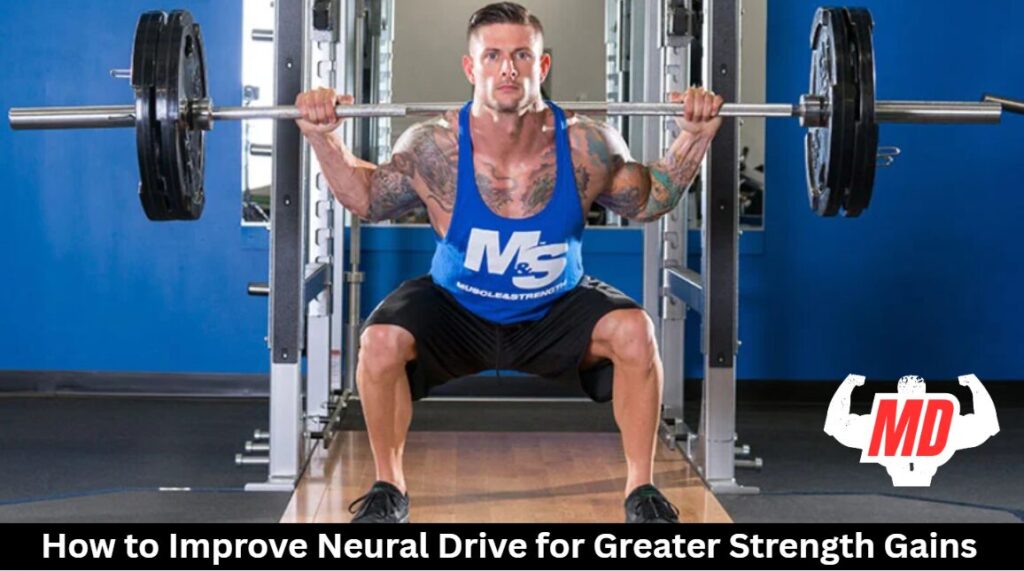
To boost neural drive, you have to train your nervous system to recruit a greater number of muscle fibers simultaneously. Focus on explosive movements with lighter weights, use post-activation potentiation by pairing heavy compounds (85–90% 1RM) with explosive exercises, and give it your all on every rep. Give yourself 48 to 72 hours between high-intensity workouts to recover properly.
Put quality before quantity, and focus on perfecting your technique with all your strength. The following methods will change how you gain strength without making your muscles grow too much.
What is Neural Drive? The Link Between the Brain and Muscles
A lot of athletes only care about building muscle mass, but neural drive is the most important link between what your brain tells your muscles to do and how much force they can make. Neural drive refers to how effectively your central nervous system activates motor units, meaning the motor neuron and the muscle fibers it directs.
When you train your body to make neural changes, you’re teaching it to use more motor units at the same time and fire them faster. This better muscle recruitment leads to stronger muscles, even if they don’t grow much. Neural drive training is great because it can lead to improvements in a short amount of time, unlike hypertrophy. Your nervous system changes in response to training stimuli in just a few days or weeks, which speeds up the process of improving your performance.

Rate of Force Development Training Techniques
Rate of force development (RFD) should be a key part of any good strength program because strength isn’t just about how much force you can make, but also how quickly you can make it. Your neural drive has a direct effect on RFD, which affects how quickly you can recruit motor units when you need them.
Add explosive movements like jump squats, medicine ball throws, and Olympic lift variations to your routine to improve RFD. These exercises help your nervous system work better when it’s under stress. Begin with lighter weights at the highest speed and then gradually raise the resistance.
For the best training adaptation, switch between days of heavy strength training and days of explosive RFD. It keeps your nerves from getting tired and makes you more responsive. Keep in mind that RFD improvements happen before hypertrophy, so it’s a great way to focus on early strength gains.

Post-Activation Potentiation Techniques for Better Muscle Firing
Post-activation potentiation (PAP) can greatly improve your neural drive when done correctly by temporarily increasing the number of muscle fibers and the amount of force they produce. It happens when a heavy strength exercise gets your nervous system ready for fast movements that come after it.
To use PAP correctly, do a heavy compound exercise (3–5 reps at 85–90% 1RM) followed by an explosive movement after 3–8 minutes of rest. For instance, do heavy squats and then vertical jumps, or bench press and then throw a medicine ball.
This method teaches your brain to activate more muscle fibers at once, which makes your neural drive better. To avoid getting too tired, start with only 1 or 2 PAP pairs per workout. The time between exercises is very important. If you don’t give your body enough time to recover, your performance will suffer.
How to Get Past Neural Inhibition with Advanced Protocols
Neural inhibition is a protective mechanism in the body that keeps you from using your full strength. It often keeps athletes from reaching their full strength potential. To get around these built-in protections, you need to use training methods that slowly convince your nervous system to let you produce more force.
Begin with post-tetanic facilitation techniques, which involve doing isometric contractions that are almost at their maximum for 5 to 8 seconds before doing explosive movements. It lowers neural inhibition for a short time, which lets your motor units fire more often. Contrast training, which involves switching between heavy loads and lighter, explosive movements, helps your brain work better by teaching your body how to stay coordinated when things change.
During these protocols, make sure to focus on perfecting your technique because bad movement patterns make inhibitory responses stronger. You want to teach your nervous system that higher force outputs are safe when done correctly.
How to Add Neural Training to Your Current Strength Program
You don’t have to change your whole workout routine to use neural-focused training successfully. Instead, use neural drive techniques on your heaviest training days when you feel the best. Start each session with 2–3 heavy compound lifts at 85–90% of your 1RM for 3–5 reps. Focus on maximum intent and bar speed to get more motor units to work.
Instead of doing more reps, do more weight to use progressive overload. Also, include one explosive exercise in each workout, like jump squats or med ball throws. Keep in mind that neural adaptations need full recovery. Give yourself 48 to 72 hours between high-intensity sessions and make sure you get enough sleep.
To see how your neural connections are getting better over time, don’t just look at how much weight you lift. Instead, keep track of things like bar speed or rate of perceived exertion.
Frequently Asked Questions
What happens to neural drive as you get older, and can older lifters make it better?
As you get older, your neural drive naturally goes down, but you can still make it better by working out regularly. To keep your nervous system working well and improve it, focus on explosive movements, proper recovery, and workouts that are good for your CNS.
Can meditation or visualization exercises help change the way neurons work together?
Yes, meditation and visualization can help recruit more neurons. Regular mental practice will help you strengthen the connections between your mind and muscles. It will make it easier for your brain to activate certain muscle fibers during real training sessions.
Do some supplements really help with the growth of neural drive?
Caffeine, creatine, and omega-3s can help your neural drive grow. Caffeine makes the nerves and muscles work better, creatine gives the nerves more energy to send signals, and omega-3s help keep nerve cells healthy and speed up transmission.
What effect do hormones like testosterone have on neural drive capacity?
Testosterone boosts your neural drive by making neurotransmitters work better, making motor neurons more excitable, and making neural networks work better. It lets you use more muscle fibers at the same time, which makes you stronger when you lift.
Does genetics limit neural drive trainability, or can it always get better?
Your genetic makeup limits your neural drive, but you’re not there yet. With the right training, you will keep getting better until you reach your genetic ceiling, which is usually much higher than what most people can do.